
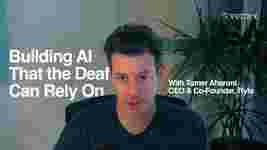
The CEO of Rylo, formerly Nagish, on why word error rate is the wrong yardstick, why accessibility fails when it sorts people into boxes, and what a captioned interview can do for a career.
The article below is based on a video interview with Tomer Aharoni, CEO and Co-Founder of Rylo.
I once signed my father up for our service. He has hearing loss and wears hearing aids, and I knew he needed what we had built. On the second step of onboarding, the app asked him a simple question: Are you deaf, or hard of hearing?
He looked at me and said, "I'm neither of those."
"Dad," I said, "you're hard of hearing."
"No," he said. "I'm hearing."
He was describing himself as he saw himself, and our product had no place for that person. We had decided, at some point, that Rylo (then Nagish) would have two modes, one for people with hearing loss and one for people who are deaf. It seemed tidy. It turned out to be one of the most instructive mistakes we have made.
Two boxes were one too many
The assumption did not stop at the sign-up screen. We had also separated the experience itself. A deaf user got a keyboard and no audio on the call. A hard-of-hearing user got audio and no keyboard.
Then the messages arrived. People with hearing loss told us they sometimes needed to type, because they have an accent that friends and family understand but strangers do not. They wanted to speak and type in the same call. Deaf users told us they wear cochlear implants and can hear to some extent, so they wanted audio flowing in. Other users told us they did not want audio at all, because it interferes with their hearing aids.
I have come to believe that a deaf person may have completely different needs from a hard-of-hearing person, and that one deaf person may have completely different needs from another. We learned the hard way that when you serve many kinds of people, everything has to be personalized. We now test our assumptions with the community every day, because we cannot build for people we have not listened to.
The wrong way to count accuracy
When I told Vertex in 2022 that AI was not perfect and would not be, I meant it. I still do. What has changed is the distance. For our use case, which is live phone calls, today's models are ten times better than what we had, maybe a hundred times. We can now caption faster, and we can add a layer of context on top of the words, which is what makes a conversation feel like a conversation. On accuracy, we are significantly ahead of human stenographers and captioners.
But the industry still measures accuracy in a way that I think misleads. The standard yardstick is word error rate: compare the engine's output with the spoken sentence and count the substitutions, removals and additions.
Take the sentence, "I'm not allergic to penicillin." A human captioner might render it as, "They said they're not allergic to penicillin." Word for word, that is a wreck, perhaps ten or fifteen percent accurate. In reality, the right message got through. An automated engine might produce, "I am allergic penicillin." It dropped a single word, so it scores far better. It also told someone the opposite of the truth, in a sentence about their health.
Context is the thing word error rate removes from the equation, and context is the thing a person on a call needs. So we are building our own internal standards and evaluation functions, designed to tell us whether a new captioning engine is better than the one before it, with no regression in meaning. The problem becomes roughly tenfold harder when we take it to sign language, which depends on facial expressions, hand gestures and the use of space. That is some of the hardest work we do.
Trust has two parts, and the second is a surprise
People will always have trust issues with technology, and with AI there are doomers who believe it will end the world. For something as personal as a phone call, privacy anxiety is real. So we say plainly that we do not use customer data for training and that calls stay completely private. We carry external certifications, including HIPAA and SOC 2, and we are FCC certified. That helps a great deal. It does not make the worry disappear, and I do not think it ever fully will.
What has surprised me is the second part. Captions give a deaf or hard-of-hearing person the words and little else. A hearing person also knows whether the speaker is angry or laughing, whether a baby is crying in the background, and whether the voice belongs to the person it claims to. So we have been building those signals into the call: sentiment, background sounds, and AI-powered fraud detection that warns you when the caller is not who they say they are.
I expected these features to raise questions about trust. They have done the opposite. They create small moments where a user gets back a feeling they have not had in a long time, or perhaps never had. In those moments nobody is thinking about AI. They are thinking that something finally works.
There is a related fear I used to carry: that AI would stumble on accents and non-standard speech in ways humans would not. I worry about it much less now. There are models that handle accents, different speakers and speech disabilities. We can even take a model and fine-tune it for one specific user, which means a deaf speaker whose voice only close friends can follow can have a speech engine built around them.
From the floor to the ceiling
This year we changed our name. Nagish is Hebrew for accessible, and it was the first word that came to mind when my co-founder Alon and I started. We never gave it real thought. Eventually we noticed that most of our users, who are mostly in the United States, could not pronounce it and that it meant nothing to them.
There was a deeper problem. To us, accessible was the floor. We wanted to empower people to communicate, which is a much higher bar. It took more than a year to find a name that fit. Rylo began as Alon's shorthand for the real-time, low-latency algorithm we were building. Do not try to make sense of that, because it does not. But it also plays on relay, the service we provide, and on rely, which is what people historically could not do with relay services. We bought Rylo.com and moved.
The company is now organized around three places where communication happens: over the phone, in person and at work. Rylo Phone replaces the native dialer on your device. Rylo Desktop is an add-on for Zoom, Microsoft Teams and Google Meet. Rylo Live Transcribe captions and voices in-person conversations. Our research team, RyloSign, builds AI models that translate sign language into speech and back again. We would love to expand beyond the United States, though we are not focused on that yet, because there is plenty left to do at home. But I expect that by 2027 and 2028 you will see Rylo used in more and more countries.
Why we will not build the glasses
People ask whether hardware is next. I do not expect us to build it soon. Hardware is hard, and we are not afraid of it, but we have a strong software business. When it comes to smart glasses, it makes more sense to bring our technology to someone else's hardware, because a company like Meta will sell its glasses in far greater numbers than any startup in the space.
I also suspect that hardware adoption will always trail software. Wearing things on your body, whether bulky glasses or bracelets and trackers, is something many people simply do not want to do.
The job interview that mattered
The example I find most moving is employment. Our own recruiter, Neta, has hearing loss. She uses our tools when she speaks with candidates. She hears what she can hear, and captions fill the gaps, so nothing gets lost. We have users who used Rylo to interview for roles in call centers and on HR teams that their hearing loss would previously have closed to them. One person got into university by passing the interview through our tools.
I want to see deaf people employed at the same rates as hearing people. I want to see people with hearing loss, who skew older, keep the jobs they already have. Revenue is a byproduct of that work. We are a for-profit company and we want to grow, but I do not think about revenue daily. I think about how many of the more than a billion people in the world with hearing loss we can reach.
About Rylo
Rylo, formerly Nagish, is a communication engine for people with hearing loss. Its FCC-certified platform makes communication more accessible in person, over the phone and at work, through Rylo Phone, Rylo Desktop and Rylo Live Transcribe, with sign language translation under development by its RyloSign research team. Learn more at rylo.com.
Vertex Ventures Israel is an investor in Rylo.